Here to Help: Familiar Faces Greet Students on the Lawrence Campus

This story originally appeared in the fall 2024 edition of alumnecc, the alumni magazine of Northern Essex Community College.

45,000. That’s how many hours- give or take- the women behind the Welcome Express desk on the Lawrence Campus have spent working together. They’ve celebrated milestones, helped each other through tough times, and become a family. But most importantly, they’ve welcomed thousands of students into the Northern Essex family.

“That personal touch is important to them,” said Ilia Colon ’11, the newest member of the team who has been at NECC for 25 years.

She joined Elizabeth Mercardo ’95, ’09 and Paula Pancorbo ’06, ’12 as an enrollment services specialist in 2003, though her connection to the college goes back much further than that.

“I first came to the college in 1995 to get my medical transcription certification,” she recalled. “I was working in a building across the street as a property manager. I had my kids young, and I was a single mother, so I was thinking about them.”

After earning her certificate, she returned to Puerto Rico, where she was born and where many of her family members still lived. A year later, she was back in Lawrence, and ready to continue her journey at NECC.

She first took a work-study role in the health program and then became an administrative assistant for the English for Speakers of Other Languages (ESOL) program in 1999. Three and a half years later, she learned about the full-time opening with Enrollment Services. The hiring manager called Colon’s supervisor for a reference, which must have been glowing because she was hired on the spot.
“It all started in this building,” she said of the Dimitry Building at 45 Franklin Street. Colon went on to earn an associate in arts: general studies degree from NECC in 2011.

Mercado had a similar experience. She received an associate degree in administrative management: travel/tourism in 1995. After an internship at Logan Airport and a short time working for the Merrimack Valley Regional Transit Authority, she saw an ad in the paper for the enrollment position at NECC and decided to apply.

“I was the last one to get interviewed and I was really hoping for this great opportunity. When I was hired, it was a dream come true. As a student, I always had that vision of one day helping other students accomplish their goals.”

That fateful day was 28 years ago. Though some of the mechanics have changed – no more paper applications, for example – the essence of the role remains the same.

“We do it all! We connect them to financial aid, we refer them to services, we’re recruiting,” Colon remarked. “But most of all, we’re a personal connection for them. Some really want and need that interaction; they don’t want to do everything online.”

Colon recalled the time a mom came in with her daughter. The daughter wasn’t sold on the idea of enrolling, but after a short talk with Colon, she decided to give it a try.

“I just told her ‘You have a lot of opportunities. My mother never told me to go to college.’ The mom came back and thanked me and said, ‘I don’t know what you did to change her mind!’ We do that all the time for our students. We want to go the extra mile.”

Mercado said it’s especially helpful that the enrollment staff in Lawrence are bilingual.

“Often, we’re talking to the student in English and then we’re translating it into Spanish for the parents. And we’re happy to do that because it’s what makes the process easier for them.”

Many of those students who benefited from that extra attention are now paying it forward.

“One of the things I love about my job is that we see the students, and then we see them come back with their children. That is – wow – I love it. We had one just today! It happens all the time, almost every day,” said Mercado.

Both women said they are reminded every day that welcoming students isn’t just a job; it’s an opportunity to change lives.

“I love working here, I love to work with the people,” reflected Colon. “I love to see people succeed.”
NECC Celebrates Black History Month

Since 1976, February has been a global celebration of Black History Month. At Northern Essex Community College, students and faculty are devoting time to celebrating the achievements and contributions of Black Americans throughout history. They are hosting a variety of events and programs to honor this important observance and help educate our community.

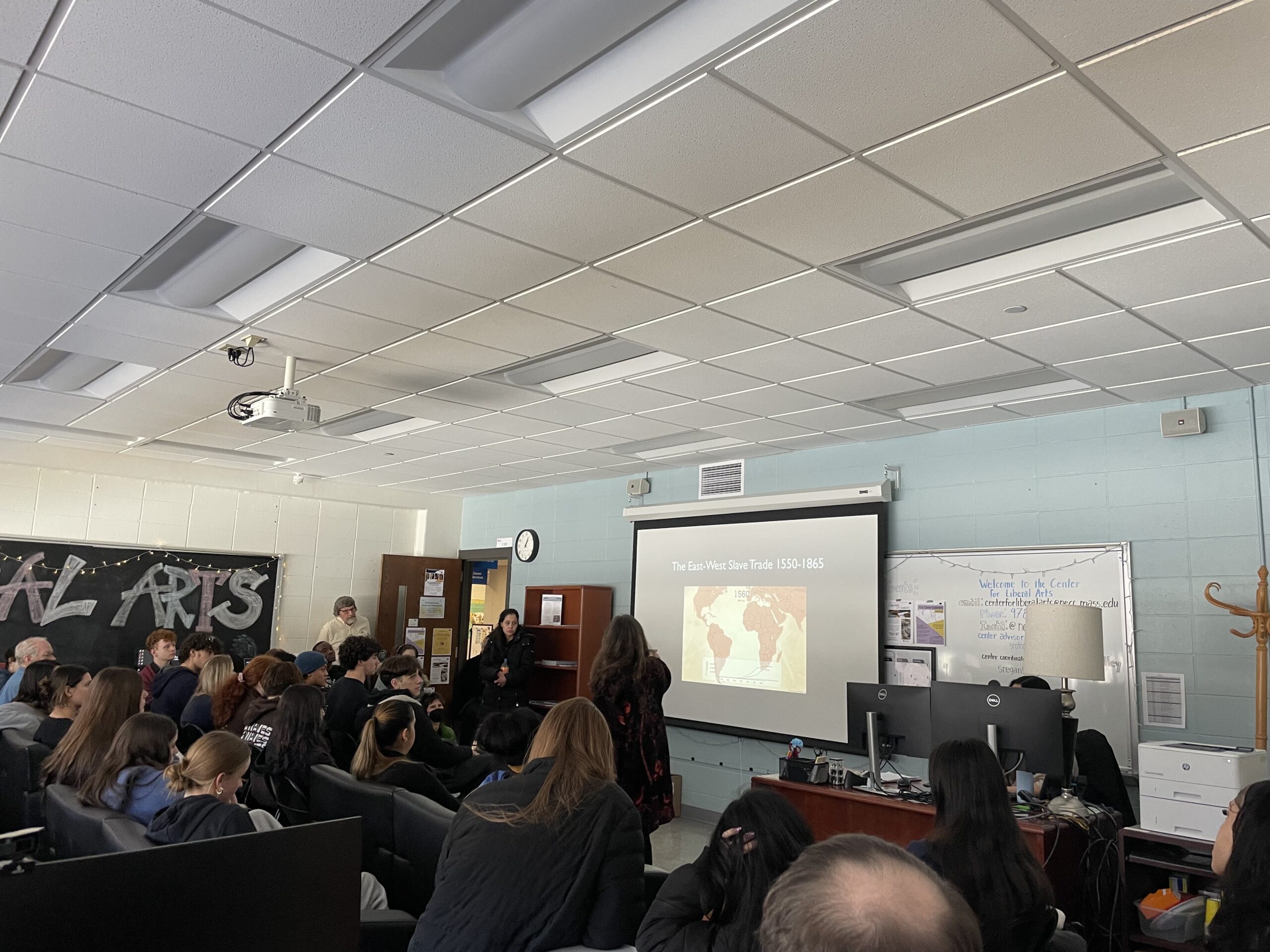
The events began on Wednesday, February 5 as the Center for Liberal Arts hosted a “Unerasing Black History” discussion presented by History Professor Steve Russell and Global Studies Chair Meredith Gunning.

It was standing-room-only as students, faculty, and staff attended the “Unerasing Black History” discussion.

Several of Professor Russell’s and Professor Gunning’s students attended this event, alongside an NECC librarian, a sociology professor, and a psychology professor.

Professor Russell began the presentation by discussing the importance of understanding “how fundamental African American labor was to building the United States of America’s modern global economic systems,” said Russell. He touched upon New England’s economy in the 18th century, specifically the “transportation of goods,” such as lumber and agricultural products produced by Black Americans, noting the essential role that played in the American economy.

A handful of students provided their thoughts on Black Americans’ impact on the U.S. economy, which transitioned into a deeper discussion of the enhancement of the 19th century when the significance of cotton and textile mills also contributed to the economy.

After questions and answers were exchanged between Russell and students, Professor Gunning took the floor.

Gunning began her presentation by having students compare and contrast the past to the modern day to comprehend the importance of how to “tackle problems of today [one must understand] past mistakes,” said Gunning.

Gunning examined the history of literature and thought it would be best to “look in our own backyard” in Boston during the Transatlantic Slave Trade, said Gunning.

According to Slavery and Remembrance, a website overseen by the United Nations Educational Scientific and Cultural Organization, “The transatlantic slave trade was an oceanic trade in African men, women, and children which lasted from the mid-sixteenth century until the 1860s.”

As a result of doing her own research about the transatlantic slave trade, Gunning wanted to put “names to faces” and honor a specific and historical slave: Phillis Wheatley, said Gunning. In 1761 Wheatley was kidnapped in Gambia, a country in West Africa. According to the National Women’s History Museum’s website, Wheatley was brought to America and “sold to the Wheatley family in Boston, Massachusetts.” During her enslavement under the Wheatley family, she was taught to read, write, and comprehend the English language. A few years later, Wheatley explored the world of poetry and writing, which led her to become “the first Black African woman to have poetry published in America,” said Gunning.

For the remainder of the event, students and faculty shared their thoughts on the importance of celebrating Black history and the significance it continues to have on America.

Wednesday’s event was the first in a series of talks, workshops, and celebrations of Black History this month. For a complete listing, visit the webpage.


President Glenn Receives Eduardo J. Padrón Award for Presidential Leadership

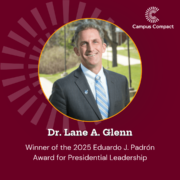
February 5, 2025 (Haverhill, MA) – Campus Compact is pleased to announce that Lane A. Glenn, Ph.D., president of Northern Essex Community College (NECC), has been awarded Campus Compact’s Eduardo J. Padrón Award for Presidential Leadership. The award recognizes presidents and chancellors from community colleges who have exemplified a deep and sustained commitment to civic and community engagement throughout their careers.

Glenn is recognized as Massachusetts’ longest-serving community college president, where his leadership and dedication to equity have made an indelible mark, not just on the communities NECC serves, but across Massachusetts and its educational institutions.

“President Glenn is a strong advocate for colleges and universities as engines of economic and workforce development—particularly in Massachusetts Gateway Cities,” said Allison M. Dolan-Wilson, Vice President of Institutional Advancement at NECC in a letter nominating Glenn for the award. “Northern Essex Community College is now in year three of Success for All, its current strategic plan. The plan seeks to remove structural barriers and create a more equitable, more diverse, and inclusive college that reflects the cultures and identities of all people who are part of the NECC community. This work would not be possible without the strong foundation laid by President Glenn.”

“President Glenn’s longtime leadership at Northern Essex Community College clearly demonstrates the unique and vital contributions that civically engaged community college leaders can make toward community development and wellbeing,” said Bobbie Laur, president of Campus Compact. “We are honored to recognize his many years of dedicated leadership in higher education civic and community engagement work with this award.”

The Eduardo J. Padrón Award for Presidential Leadership is presented as part of Campus Compact’s Impact Awards, which recognize shining examples of meaningful, impactful higher education civic and community engagement work. Read more about the other awards and this year’s recipients here.

The recipients of these awards will be recognized at Compact25, Campus Compact’s annual conference, which will be held in Atlanta, Georgia from March 31st – April 2nd, 2025.

Training the Trainers: NECC Police Academy Instructors Equipped with “Gold Standard” Response Curriculum

Content note: this story includes brief descriptions and photos of simulated active shooter events. 

It’s a situation no one hopes to face: an attacker is targeting or among a group of people. And yet, it’s a reality for thousands of people each year.

Should an active attacker situation happen, officers who train at the NECC Police Academy will be equipped with the latest response method called ALERRT. The FBI has deemed ALERRT– which stands for Advanced Law Enforcement Rapid Response Training –  the gold standard in response curriculum. The course is designed to improve the safety and survivability of victims of active attack/shooter events and increase the effectiveness, coordination, and resource integration between law enforcement, fire, telecommunication, and EMS.

“Active Shooter and Hostile Event Response training is critical to ensuring first responders are prepared to act decisively and collaboratively during life-threatening emergencies,” said Municipal Police Training Committee Statewide Director of Active Shooter Hostile Event Response John J. Mazza. “The recent ALERRT train-the-trainer program is imperative in rolling out the most up-to-date curriculum and contributing to the Commonwealth’s mission to advance multi-agency preparedness and community resilience.”

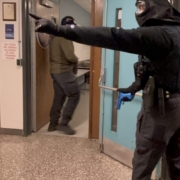
The Municipal Police Training Committee (MPTC) held the four-day intensive Train the Trainer course for NECC Policy Academy instructors earlier this month. The program included classroom time during the day and extensive simulated shooting drills in the evenings. The hallway of the first floor of the E Building on the Haverhill Campus transformed as officers donned protective gear and armed themselves with training guns that shoot blanks.

In one scenario, officers responded to a report of an armed robbery. Upon seeing the police, the attacker shot one victim and then fled into a crowded room. Officers had to identify and disarm the shooter quickly, secure the room, and triage the victim. Another simulation involved a shooter who attempted to blend in with fleeing bystanders and a plain-clothed officer who was injured. Responding officers used their training to communicate quickly and clearly to identify who was the threat.

Student officers of the MPTC-NECC Police Academy 5th Recruit Officer Class (ROC-05) who graduated in the spring of 2024 were the first to receive the ALERRT training. This month’s Train the Trainer event ensures the academy has a deep pool of ALERRT instructors for current and future classes. Trainers at the event were law enforcement officers from local cities, towns, and counties. The group also included several FBI agents.

ALERRT was created in 2002 as a partnership between Texas State University and Texas state and local law enforcement. ALERRT has a criminal justice research department that works continuously to evaluate and enhance the overall understanding of active shooter events and assist in improving law enforcement best practices. In 2013, ALERRT at Texas State was named the National Standard in Active Shooter Response Training by the FBI. Since then, it has been rolled out nationally, and the ALERRT curriculum has been adopted by numerous states and agencies. All student officers who attend an MPTC Police Academy in Massachusetts will receive ALERRT training.

The MPTC-NECC Police Academy provides student officers with over 800 hours of intensive training to prepare them to serve as full-time officers in municipalities and police agencies across the state. In addition to the ALERRT training, the MPTC Recruit Officer Course (ROC) curriculum includes de-escalation training based on new use-of-force policies and regulations. Student officers also receive uniform training based on best practices related to essential modern-day policing needs, including effective communication skills, victim-centered and trauma-informed incident response, missing persons and human trafficking investigations, mental health-related emergency response, patrol duties, and officer safety and wellness.

To learn more about the MPTC-NECC Police Academy, visit the webpage or contact Director Joshua Stokel.


Alumni Q&A: Meet Sarah Tavitian ’19

NECC alumna Sarah Tavitian '19

Alumna Sarah Tavitian

Occupation: Small Business Developer, NewVue Communities

What initially inspired you to attend NECC? Where were you on your professional/personal journey prior to enrolling?

When I graduated from Haverhill High School, I did not know what I wanted to do for a career. I knew I loved the business world but was not in a position to spend hundreds of thousands of dollars on a degree I wasn’t passionate about yet. My older brother attended Northern Essex Community College a few years prior to me and always sang its praises for the faculty, education, and career opportunities he received. Additionally, I was working part time as a server, receptionist, and nurse’s aide to put myself through college, so the flexibility of courses offered at Northern Essex worked perfectly for my situation.

I’d love to hear more about your career journey. What led you to your current position as a small business developer?

After receiving my associate degree from Northern Essex, I transferred to UMass Amherst and received a bachelor’s degree in marketing. After UMass, I attended Fitchburg State University for an MBA in Human Resource Management. During my time at FSU, I was presented with an internship at the company I work for now, NewVue Communities. I was a Small Business Intern for over a year and went on full time as a Small Business Developer upon graduation.

What did you enjoy most about your experience at NECC? Any favorite memories to share?

Northern Essex, from start to finish, was a personalized experience. The stigma surrounding community college at the time was that everyone “goes to class and goes home.” However, I was very active with extracurriculars in high school and did not want that to end just because I attended community college. At Northern Essex, I joined the business honor society, Alpha Beta Gamma, Phi Theta Kappa, and the National Society of Leadership & Success. Some of my fondest memories are running bake sales in the lobby of NECC for the aforementioned clubs and sitting down with the “adult coloring for stress relief” group. I made several connections with peers and faculty, that led to many coffee outings and dinners. One of my favorite memories would be attending an Alpha Beta Gamma Convention with Professor Pamela Donahue in Jacksonville, Florida.

What do you enjoy most about your work?

As a Small Business Developer, I provide business owners and aspiring business owners with technical assistance and business coaching. I work with clients on a business plan and financial projections that oftentimes get submitted for a loan or grant. When the client receives funding to open or expand their business and has a ribbon cutting ceremony, that is the part I enjoy most. Watching a client succeed after all their hard work is a rewarding feeling that I am grateful I get to experience.

Anything else you’d like our audiences to know about you? 

Northern Essex Community College gave me a foundation in the business world that carried me through my academic career. I am grateful for every opportunity and faculty member that contributed to my growth as a professional.

Each month, the NECC Alumni Office shares interviews with our accomplished graduate population through its alumni newsletter. If you have a story to share and would like to be considered for a future edition, please fill in an Alumni Update Form or email alumni@necc.mass.edu

Grant Award to Create First-of-its-Kind Classroom Support Specialist Program 

Haverhill, MA (January 27, 2025) – Northern Essex Community College is the recipient of a new, $170,000 grant from The Peter and Elizabeth C. Tower Foundation, to create a Classroom Support Specialist Program. The program is designed to “increase college success for complex learners” through additional supports inside the classroom for faculty and students, and additional training and awareness for NECC faculty, staff, tutors, and academic coaches.

NECC’s Director of the Center for Accessibility Resources & Services (CARS) Susan Martin says the need for such support has been growing steadily since the pandemic. Faculty and staff report wider gaps in learning and more mental health concerns among students. Programs like MassEducate and a new education initiative for individuals with intellectual disabilities have also brought a broader, more diverse group of learners to classrooms, with a wider array of needs.

“It doesn’t take long for students to realize their skills aren’t the same as the person next to them. Something small can discourage students and make them not want to return to class,” says Martin.

“Technology is a really big part of it,” echoes DJ Chase, an NECC alum, now an Accessible Media and UDL Specialist with CARS. “We have students who don’t use computers regularly, yet nearly everything they need to access for class is online. The specialist will be able to incorporate assistive technology to aid in their learning.”

The classroom specialist would be on hand to address student needs in the classrooms, in real time. If a student needs help logging into computer programs, is struggling to follow the directions given in class, or is struggling to regulate their emotions, the specialist can help them work through challenges like those so that their learning can continue. This will also allow faculty to continue with their instruction and limit interruptions to the class.

The Center for Accessibility Resources & Services provides various accommodations for students with diagnosed disabilities. Martin says they’ve seen an increase in accommodation requests in recent years; this year, about 12% of students are receiving support through the center. However, she and Chase estimate many more students have an undiagnosed disability and, therefore, can’t or won’t seek accommodations. The classroom specialist can be especially vital in supporting those students.

“We estimate about a fifth of college students have some sort of disability,” says Chase. “We see nowhere near that amount of students in CARS. There’s still a stigma around disability so some are hesitant to pursue a diagnosis. It can also be really expensive and time-consuming to get a diagnosis once a student is out of high school.”

The Classroom Specialist Program will start with two pilot classrooms. Faculty, students, and staff will be surveyed regularly about their experiences, and feedback will be used to make adjustments. Martin says this program could serve as a model for other institutions and be incorporated into other support services already available at NECC and other community colleges.

Funding for the Classroom Specialist Program comes from The Peter and Elizabeth C. Tower Foundation. The nonprofit works to support young people, from birth to age 26, who have intellectual disabilities, learning disabilities, mental health issues, and/or substance use disorders. The Classroom Specialist Program is also complemented by a $20,000 grant from the John W. Alden Trust to purchase new assistive technology.

To learn more about how Northern Essex supports complex learners and the Center for Accessibility Resources & Services, visit the webpage or contact Martin at smartin@necc.mass.edu.

Faculty Nationally Recognized with 2025 NISOD Awards

Two members of the Northern Essex Community College faculty were recently named recipients of the National Institute for Staff and Organizational Development (NISOD) Awards for Excellence. This national honor recognizes outstanding faculty and staff at the country’s community colleges.

Dean Jody Carson, Prof. Sheila Muller, Dean Carolyn Knoepfler, Prof. Habib Maagoul, Assist. Provost Sharon McDermot, President Lane Glenn

Associate Professor Sheila Muller is in her seventh year as a full-time faculty member in the Business Department at NECC. Before becoming full-time, Muller served as an adjunct faculty member. Muller has taken on a number of leadership roles at the college, serving as both the chair of the Business Department and Chair of the All-College Assembly. She recently led the creation and implementation of two new business programs and is involved in developing a competency-based degree option in Business Management. Nominator Dean of Business and Professional Studies Jody Carson wrote: “She is responsive to requests, checks in on others to make sure they are doing well, and helps whenever needed. Sheila goes above and beyond each day and somehow gets everything done!”

Professor of Mathematics Habib Maagoul has also undertaken many leadership roles outside of the classroom. He is currently the Mathematics Department chair and chair of the Academic Affairs Committee. Maagoul has been instrumental in enhancing student preparedness for college mathematics by working directly with local high schools and back-mapping courses. Additionally, he worked on developing an assessment for Early College students outside of the Accuplacer exam called Guided Placement. Nominator Dean of STEM Carolyn Knoepfler wrote: “Habib has been a mentor to many and is always willing to help anyone in any capacity.”

Since 1978, NISOD has been dedicated to the professional development of faculty, administrators, and staff, and the continued improvement of teaching and learning, with the ultimate goal of student success. NISOD’s Excellence Awards recognize college employees each year who have demonstrated an outstanding commitment and contribution to students and colleagues. Excellence Award recipients are recognized during NISOD’s annual international conference, which will be held in Austin, Texas, May 24-27.

Board of Trustees December 2024 Update

The Northern Essex Community College Board of Trustees gathered for its last meeting of the calendar year on December 11 on the Lawrence Campus. The agenda included an update on the college’s finances, details of the next steps in exploring building a new high school for Whittier Tech on NECC’s Haverhill Campus, and a report from the Liberal Arts division.

Audit and Finance Committee Report

The meeting began with a brief update from the Audit and Finance Committee. Trustee Lloyd Hamm, Jr. said auditors praised the work of the college’s management and finance teams. He noted that increased credit hours have contributed to an overall increase in revenues. “We’re all pleased with the [college’s financial] position,” he added.

Education Report

Liberal Arts Dean Amy Callahan shared an impressive list of accomplishments and initiatives from her area with the Trustees. She praised the dedication of the Liberal Arts faculty to the mission of the college. Currently, there are 27 full-time and 70 part-time Liberal Arts faculty members. Students can choose from seven Liberal Arts majors. Callahan highlighted how they’ve enhanced the student experience by incorporating experiential learning (EL) into many classes.

“I’m very proud of the work we’re doing around EL,” she said. “We try to emphasize EL in the Liberal arts, beyond internships. We build things that students do into our classes. For example, our music classes have performances built in and we have art gallery shows featuring student works.” Journalism students also contribute to the student newspaper, the NECC Observer, as part of their classwork.

“Not every school has a student free press. You can’t have a healthy democracy without a healthy, functioning free press,” she pointed out.

The success of “Hurricane Diane” is an example of a stellar year for the Liberal Arts Division

The NECC Observer regularly wins awards from The New England Newspaper and Press Association and the Columbia Scholastic Press Association. This year another Liberal Arts publication, the literary magazine Parnanus, won a national Pacemaker award from the Associated Collegiate Press, making it one of the top student collegiate magazines in the country. Callahan also reminded the Trustees about the theater program’s juggernaut production of “Hurricane Diane,” which won 13 national awards from the Kennedy Center American College Theater Festival.

Report of the Administration

President Lane Glenn updated the Trustees on the exploration of a shared campus model between NECC and Whittier Tech. High School. At the time of the December Trustees meeting, a vote was expected shortly on whether Whittier Tech High School would be invited into the Massachusetts School Building Authority (MSBA) Eligibility Phase. (Whittier Tech was admitted to the eligibility phase on December 13.) President Glenn noted that Trustees can expect to see the results of a series of public listening sessions conducted by the UMass Donahue Institute in early 2025.

“The Donahue Institute is nearly finished with its report. It will lay out a few recommendations and paint a picture of what combined institutions might look like. We’re making progress,” said Glenn.

Updates on the Whittier project can be found on the webpage.

The NECC Board of Trustees includes nine members whom the governor of the state appoints to a maximum of two five-year terms, as well as an alumni-elected member, who also serves a maximum of ten years, and the student trustee who serves for two semesters. The next board meeting will be held February 5 on the Haverhill Campus. A full list of meeting dates and more information about the Board of Trustees can be found on the webpage.

Fall 2024 Dean’s List

Congratulations to the Northern Essex Community College students on the Fall 2024 Dean’s List!

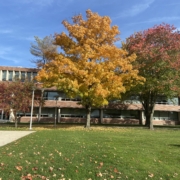
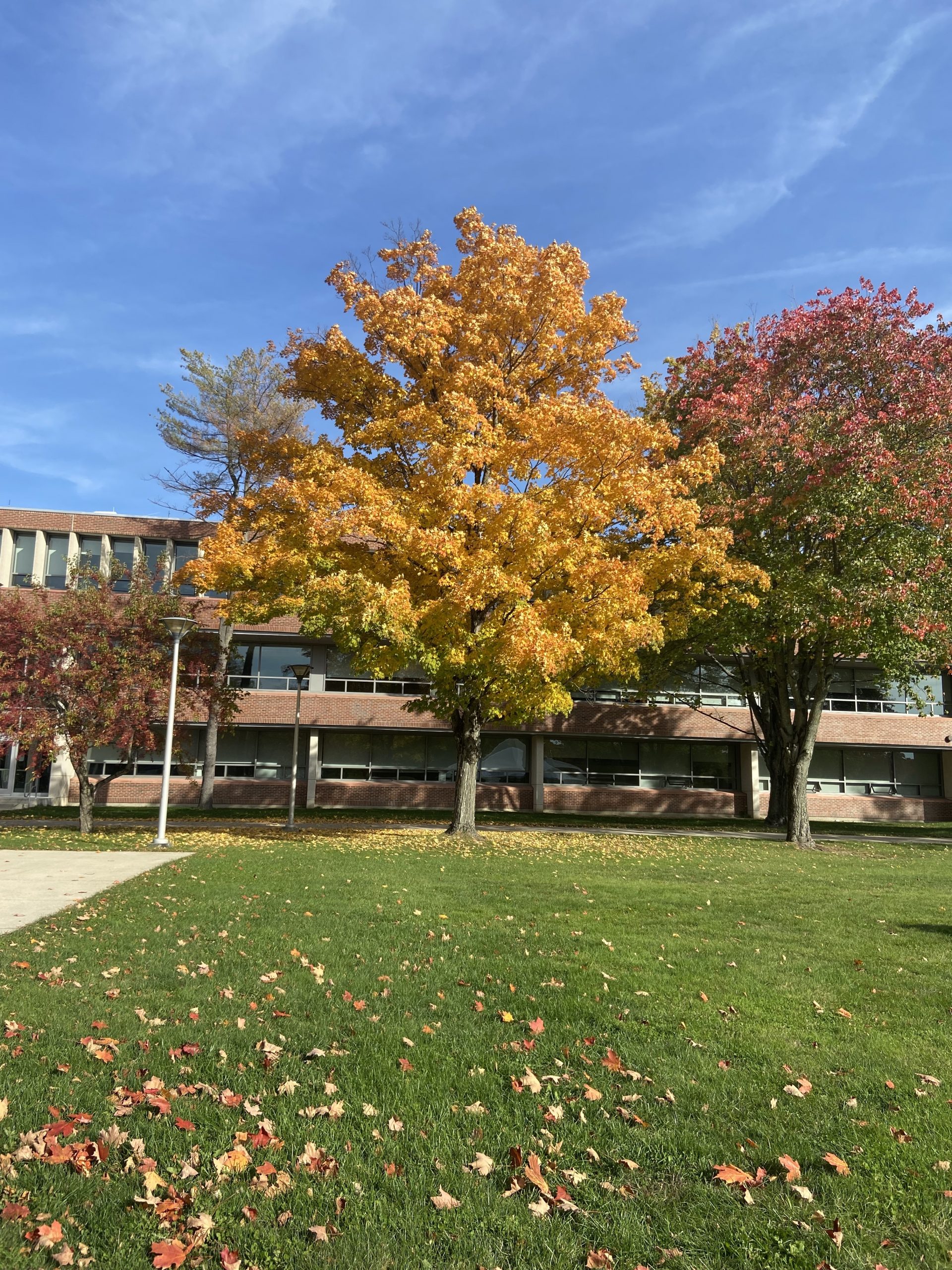
a tree with bright yellow leaves is in the center flanked by smaller trees with red leaves. the spurk building is in the background

Fall on the Haverhill Campus

To be included, students must attain a grade point average of 3.3 or higher within the term, carry six or more credits within the term, and be matriculated in a degree program.

View the Fall 2024 Dean’s List here.

Northern Essex Community College, the first Federally designated Hispanic Serving Institution in New England, is an education leader for the Merrimack Valley. Through a supportive learning environment and cultural inclusion, NECC embraces all identities and inspires initiative and excellence through top-notch affordable certificate and associate degree programs online and at campuses in Haverhill and Lawrence. NECC offers many bachelor’s degree transfer options, workforce development, and community education classes, and is host to the NECC Police Academy, MassHire Merrimack Valley, and Gallaudet University’s Regional Center for the deaf and hard of hearing. Visit Northern Essex online at necc.edu.

NECC to Receive Expanded State Grant Funding for Early College Program

Boston, MA (January 7, 2025) – The Healey-Driscoll Administration announced today that it is awarding $8 million in designated Early College grants to allow high school students to take college classes and earn college credit at no cost to them or their families. These funds will be used to support schools and higher education institutions as they design new Early College programs, as well as expand existing programs to provide an estimated additional 2,300 seats, increase staffing and recruitment, and provide professional development. Early college programs are a key part of the administration’s “Reimagining High School” initiative, ensuring Massachusetts students are prepared for college or careers when they graduate high school.

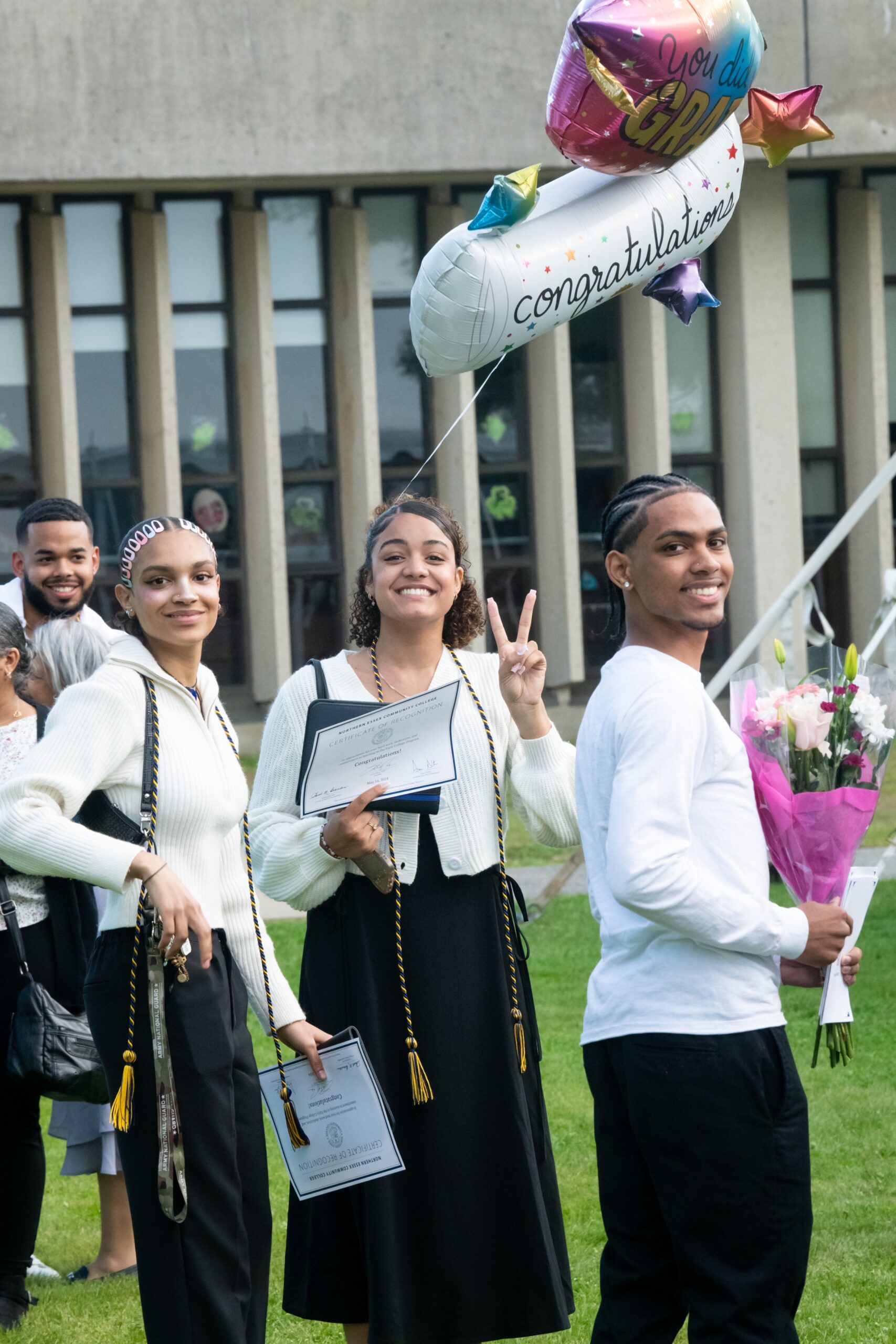
three students in white tops and black pants smile at the camera. one is holding a bunch of balloons with the word "congratulations"

2024 Early College graduates

“Early College programs are great for our students and great for our economy. They allow students to get college credit while they’re still in high school at no cost, making it more affordable for them to get their degree and preparing them to succeed in their careers,” said Governor Maura Healey. “We’re also strengthening our workforce by helping students graduate with the skills that are in demand by employers today. We’re proud to be expanding Early College to more schools than ever.”

Statewide, 55 institutions have Early College Designation status. For years, NECC has proudly partnered with three local high schools that hold Early College Designation status; Lawrence High School (since 2018), Haverhill High School (since 2019), and Whittier Regional Vocational Technical High School (since 2021). EC-designated programs are designed to empower students who are traditionally underrepresented in higher education, helping them to gain access to and find success in college coursework. Statewide data reports that EC students are more likely to attend college immediately after high school graduation and more likely to persist from year one to year two.

“Designated Early College programs have been especially meaningful in Gateway Cities, rural communities, and other districts that serve large numbers of potential first-generation college students,” said Lieutenant Governor Kim Driscoll. “I’m pleased to see continued interest from districts and colleges in expanding existing programs and adding new ones.”

The new funding from the Healey-Driscoll Administration will be spread across all 55 existing designated Early College programs. They will receive $50,000 to $125,000 to continue their work. NECC will receive $60,000 from the Early College Capacity Grant.

The Early College program at NECC has grown from 250 students when it began in 2018 to over 1,000 students participating this year. Students choose one of six pathways when joining: Liberal Arts, Education, Criminal Justice, STEM, Health Care or Business. They come to NECC from 25 local high schools and home school programs.

Early College students who wish to continue their education at NECC following their high school graduation can often do so for free, by utilizing one of the college’s Promise Programs. Students must earn at least 15 credits in Early College and maintain a GPA of 3.0 or higher to be eligible. Learn more about the Promise Programs and Early College at Northern Essex here.